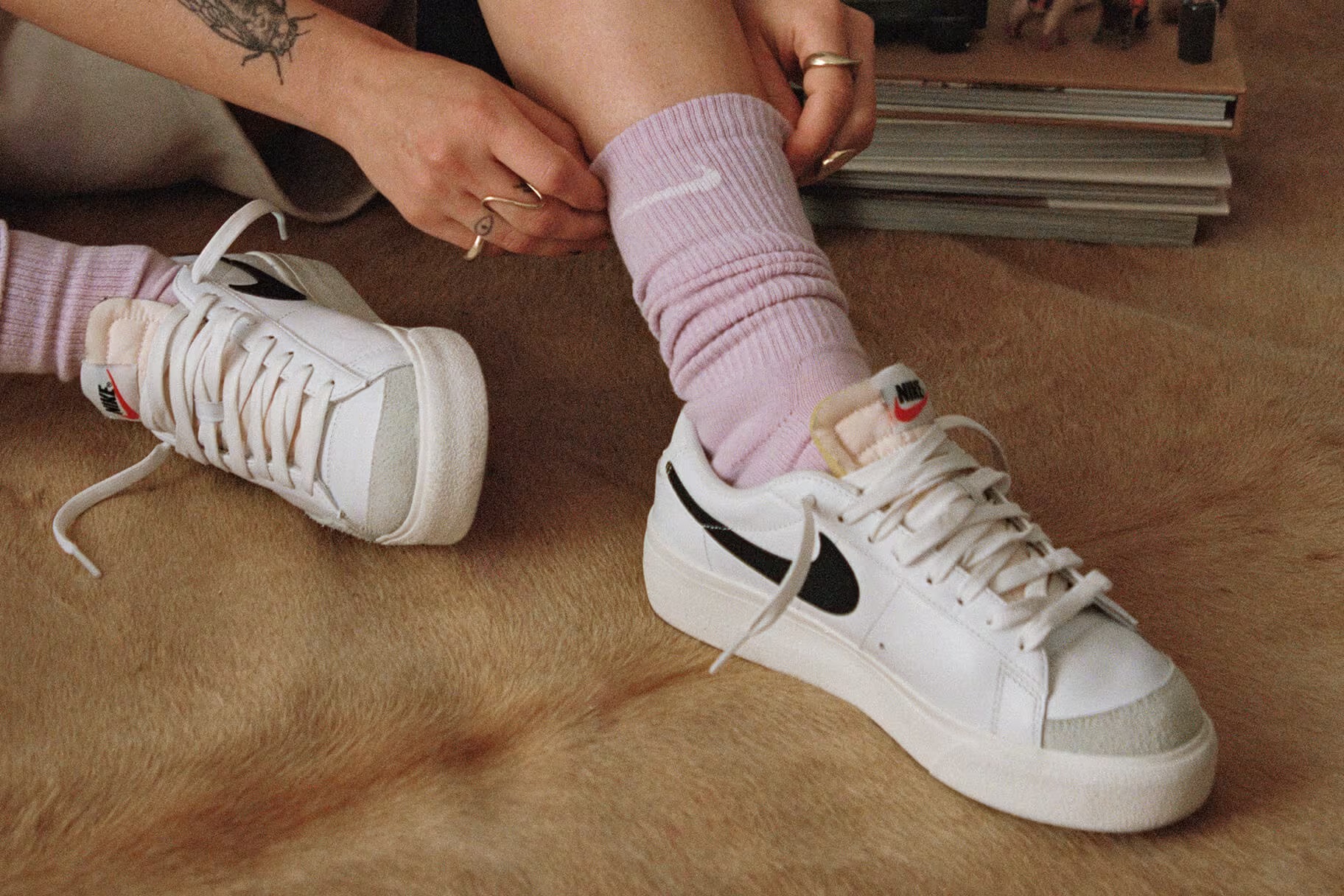
Nike Sneakers
On the basketball court, Nike's dominance is so complete it barely warrants a debate. In lifestyle, the picture is more complicated. The Air Force 1 and the Dunk — two silhouettes that carried Nike's lifestyle business for a decade — hit saturation point around 2023. adidas took share with the Samba. New Balance took share with the 550. Nike's own stock dropped over 30% in 2024 while adidas gained nearly the same amount. The Swoosh is still the biggest brand in the world. But in lifestyle sneakers specifically, it's in the middle of a comeback attempt — not a victory lap.
Air Force 1, Dunk, Air Max: the silhouettes that built Nike lifestyle — and the saturation problem that followed
The strategy worked until it didn't. During the pandemic, Nike leaned hard on its three biggest lifestyle franchises — the Air Force 1, the Dunk, and the Air Jordan 1 — flooding the market with colorways and collaborations at a pace that eventually broke the desirability equation.
In fiscal 2024, Dunks accounted for about 18% of Nike's total footwear sales, approximately $5.85 billion — making it one of the largest sneaker lines in history. The problem was volume. GOAT lists 4,700 distinct Nike Dunk models on its site. When a shoe is everywhere, it stops feeling special. Analysts predict the Dunk business will shrink to just $1.75 billion in Nike's next fiscal year — a 70% drop that reflects both deliberate scaling back and genuine demand erosion.
The Air Force 1 followed the same arc. Nike confirmed it would be pulling back supply of the Air Force 1 as a response to oversaturation, with many once-coveted icons ending up on sales racks. Nike's FY2025 revenue fell 10% to $46.3 billion as the company cleared excess inventory and reduced production of aging lifestyle sneakers. The reset is painful but necessary.
adidas took the Samba moment, New Balance took the 550 moment — what did Nike lose and where?
The market share numbers tell a contained story. Nike's global market share dropped to 16.4% in 2024 from 17.1% in 2022, while adidas holds 9%. Less than one percentage point lost — which sounds manageable until you factor in that adidas and New Balance gained that share precisely in the lifestyle segment where Nike was weakest.
In the resale market, challenger brands like ASICS gained 589% and adidas gained 88%, while Nike and Jordan saw their resale market share drop 11% and 12% respectively from 2023 to 2024. Resale is the leading indicator — it shows what the culture actually wants before it shows up in retail revenue. By that measure, Nike's lifestyle credibility eroded significantly faster than the headline numbers suggest.
The cultural shift is harder to quantify but easier to feel. Sneaker consumers began to turn to other brands and models after getting tired of the many Dunks, Air Force 1s, and Air Jordan 1s that Nike rolled out incessantly. Nike didn't lose the market. It bored it.
Air Max: Nike's deepest lifestyle franchise — and why it still matters in 2026
The Air Max series was born in 1987 with the Air Max 1, and has since produced iconic models like the Air Max 90, 95, 97, and 270. Nearly 40 years of continuous releases, each generation adding a design language and a cultural moment that the next one references.
The Air Max 1, designed by Tinker Hatfield and inspired by the exposed architecture of the Centre Pompidou in Paris, introduced the visible Air unit. The Air Max 95, with its human anatomy-inspired design, turned a running shoe into a hip-hop staple. The Air Max 97 became so popular with Italian ravers and graffiti artists that they nicknamed it "Le Silver" — in France, the Air Max Plus became "La Requin," the Shark, for its sleek profile. These aren't just shoes. They're cultural documents.
In 2026, Nike's Air Max lineup is more lifestyle-focused than performance-oriented, with the modern DN and DN8 carrying the technology forward while original designs enjoy retro releases, limited editions, and collaborations. The Air Max 95 "Neon" and Air Max 90 "Infrared" remain the two most anticipated annual retros — colorways so embedded in sneaker culture that their re-releases generate guaranteed demand regardless of what else is happening in the market.
The retro answer: Jordan 1s, Cortez, and Nike's attempt to reclaim lifestyle credibility through its own archive
Nike's response to the archive wave from adidas and New Balance is to run its own — selectively. The Cortez, one of Nike's oldest running silhouettes, has been repositioned as a lifestyle shoe. The Field General and the LD-1000 have been flagged by CEO Elliott Hill as prospective breakout models.
Nike's CEO Elliott Hill has vowed to reduce the size of the Air Force 1, Air Jordan 1, and Dunk lifestyle lines to balance the product offering and make room for fresher designs. The logic is sound: scarcity restores desirability. The execution will take two to three years to show results.
The honest assessment is that Nike's archive is as deep as any brand's — deeper than adidas, deeper than New Balance. The Air Max lineage alone spans 40 years of design history. The question isn't whether Nike has archive material. It's whether the brand can reintroduce it with the restraint and cultural framing that adidas applied to the Samba — rather than the volume approach that killed the Dunk.
Travis Scott, Sacai, Jacquemus: the collab ecosystem that keeps Nike culturally relevant even when the mainline stumbles
If Nike's mainline lifestyle business has been struggling, its collab output has not. Travis Scott x Jordan collabs averaged $451 resale in 2024 — a 197% markup over retail. The Mocha Jordan 1s from 2023 still trade above $1,000. The Travis Scott x Fragment x Air Jordan 1 Low, released at $155 retail in November 2025, averaged $1,700 on StockX at launch.
Sacai's architectural reworkings of Nike classics — the LDV Waffle, the Blazer, the Vaporwaffle — occupy a different tier: fashion-forward, conceptually driven, priced at the premium end. Jacquemus brought Nike into luxury fashion week territory with minimalist reinterpretations that generated press coverage no performance campaign could match.
This collab ecosystem serves a specific strategic function: it keeps Nike present in the cultural conversation during a period when the mainline product is being reset. Even buyers who wouldn't touch a general release Dunk in 2025 are watching for the next Travis Scott drop. The halo effect is real, and it's one of Nike's most durable competitive advantages — no other brand has a collab roster with equivalent cultural weight across this many different creative territories simultaneously.
What Nike is betting on for 2026: the comeback strategy and whether it's working
Elliott Hill's turnaround strategy has two legs. The first is scarcity restoration — pull back the Air Force 1, Dunk, and Jordan 1 supply until they feel special again. The second is performance reinvestment — rebuild Nike's credibility in running and training, which had been ceded to On and Hoka during the lifestyle pivot years.
Nike veteran Elliott Hill came out of retirement to take the top job in October 2024, implementing a "Win Now" strategy aimed at regaining the trust of both athletes and wholesale partners. Revenue for the quarter ending February 2025 beat estimates by 11%, but still fell 9% to $11.3 billion. The reset is working structurally — excess inventory is clearing. Whether it translates into genuine cultural momentum is a 2026-2027 story.
In lifestyle specifically, the early signals are encouraging. The Cortez revival is generating organic interest. The collab pipeline remains strong. And the scarcity play — counterintuitive as it sounds — is the right move. Nike built its lifestyle dominance on desirability. Restoring that means producing less, not more.
Here's what's next from Nike — drops worth your attention
Nike's release calendar remains one of the most active in the market — collab drops, Jordan retros, Air Max updates, and the emerging new silhouettes that Hill is betting on for the brand's next chapter. The pace of interesting drops hasn't slowed, even as the mainline has been scaled back.
We track every confirmed Nike lifestyle release on this page — retail price, drop date, and whether it's worth moving on at launch or waiting for the secondary market to settle.